The Reverend Who Wasn't
Martin Luther King Jr. denied the virgin birth, bodily resurrection, and deity of Christ. Can we call him "Reverend" when he rejected the very Gospel itself?

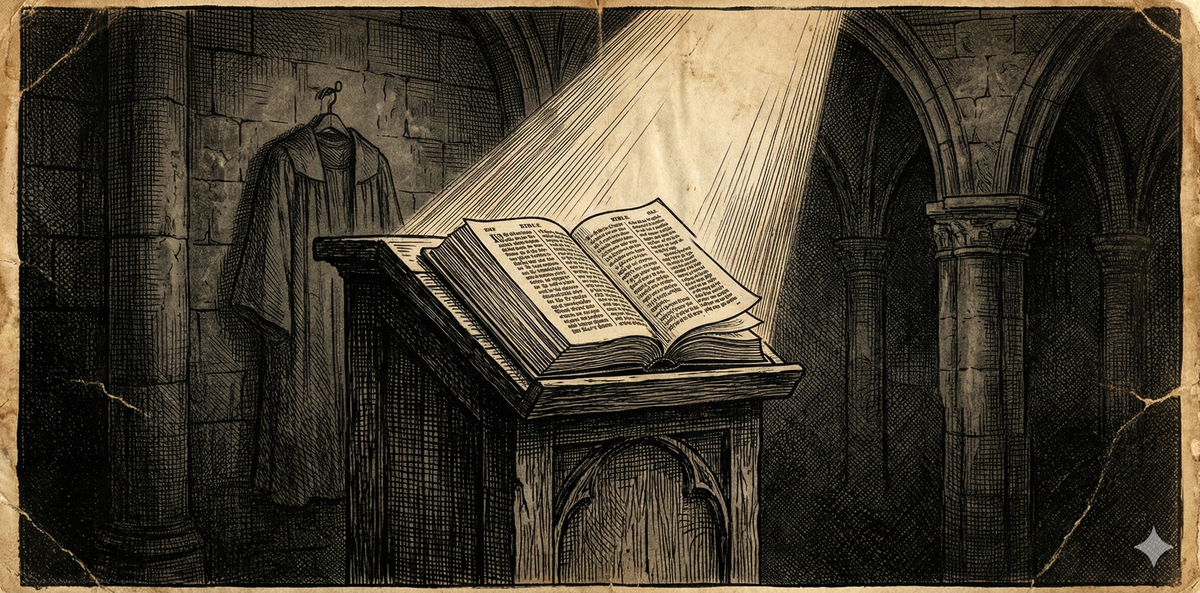
The title "Reverend" carries weight—or it should. It means a man set apart to proclaim the Gospel, to guard the faith once for all delivered to the saints, to shepherd souls toward Christ. When we pin that title on someone, we're saying something profound: this man stands in the pulpit, not by his own authority, but by GOD's. He speaks not his own words but the words of eternal life.
So what happens when the man bearing that title has denied the very Gospel he was ostensibly ordained to preach?
Reverend in Demeanor, Not in Doctrine
Martin Luther King Jr. carried himself with the bearing of a reverend: the robes, the credentials, the moral authority. And, by all accounts, he looked the part, spoke the part, and dressed the part. What he didn't do is believe the part. We've spent decades talking about his civic contributions, his rhetoric, his political legacy—all legitimate topics. But there's one question many avoid: was the man who called himself "Reverend" Biblically qualified to even stand in a Christian pulpit at all?
The answer, drawn from his own academic work and theological writings, is stark. Martin Luther King, Jr. rejected core Christian orthodoxy—not as simply some youthful phase he later outgrew, but as settled conviction he maintained throughout the life of his "ministry." This isn't speculation or character assassination. This is documented fact, preserved for our objective examination in his own papers at Crozer Theological Seminary and his doctoral dissertation at Boston University.
What He Actually Denied
Let's be precise. King denied the virgin birth, calling it "unscientific and untenable" in his seminary papers. He rejected the bodily resurrection of Christ—a position he held from the age of thirteen and never repudiated in any of his academic work. He denied the deity of Christ, writing explicitly that "the orthodox view of the divinity of Christ is in my mind quite readily denied." He rejected substitutionary atonement, the doctrine that Christ's death on the cross satisfied GOD's wrath against sin and reconciled sinners to a holy GOD.
These aren't minor theological quibbles; they're the load-bearing pillars of Christian orthodoxy. Remove the virgin birth, and you've removed the incarnation—GOD taking on human flesh. Remove the bodily resurrection, and Paul's assessment in 1 Corinthians 15 stands: our faith is futile, we're still in our sins, and we (Christians) are to be pitied above all people. Remove Christ's deity, and you've got a moral teacher with a pitiable "GOD complex," not the actual GOD-man who, alone, could bridge the infinite chasm between holy GOD and sinful man. Remove substitutionary atonement, and the cross becomes mere martyrdom—inspiring, perhaps, but powerless to actually save anyone.
King embraced theological liberalism wholesale. He drew heavily from Walter Rauschenbusch and the social gospel movement, which subordinates personal salvation to societal transformation. The Kingdom of GOD, in this framework, is not the reign of Christ over redeemed hearts but a this-worldly utopia achieved through political activism. The Gospel becomes a social program. Sin becomes systemic injustice. Salvation becomes liberation from oppressive structures.
Neither Broken Clock Nor Crooked Stick
In an earlier post, I drew a distinction between broken clocks and crooked sticks. A broken clock is right twice a day by accident—an unreliable source stumbling into occasional truth. A crooked stick is a flawed instrument deliberately used by GOD to draw straight lines—Providence working through weak vessels for sovereign purposes.
Martin Luther King Jr. fits neither category when it comes to the Gospel.
A broken clock at least tells the truth periodically, even if unintentionally. But King didn't accidentally affirm orthodox Christianity; he consciously rejected it. He wasn't unreliable on the Gospel—he was opposed to it. And he wasn't a crooked stick in GOD's hand to advance the Gospel, because the gospel he preached wasn't the Gospel at all. Second Corinthians 11:3-4 warns about those who preach "another Jesus" and "a different gospel." Galatians 1:8-9 goes further, pronouncing anathema—a very strong curse—on those who preach a gospel contrary to what he and the other apostles delivered. Paul didn't mince words, and neither should we.
This creates a category problem we desperately need to acknowledge. A civic hero is not the same as a Christian hero. We can recognize King's contributions to civil rights without baptizing them with Christian vocabulary. We can appreciate his rhetorical gifts without pretending they were used in service of Christian truth. But what we cannot do—what we must not do—is hold him up as a model of Christian leadership when he denied the very LORD he claimed to serve.
The Danger of Conflation
Here's why this matters beyond historical accuracy. Every time we treat King as a Christian hero rather than what he actually was—a theological liberal who used Christian vocabulary for social ends—we reinforce a devastating lie: that the Gospel is fundamentally about temporal justice rather than eternal salvation. That the cross is a symbol of resistance rather than substitutionary atonement. That Jesus came primarily to fix society rather than to save sinners.
This is the same error Joel Osteen makes, just dressed in different clothes. Osteen avoids the cross because it's offensive; King redefined the cross as social martyrdom because substitutionary atonement conflicted with his liberalism. Both result in the same thing: a Christianity stripped of its power to save, reduced to moral instruction or political activism. The name is still there, The vocabulary remains, but the substance has been completely gutted.
And here's the tragic irony: the so-called * black church—historically one of the most theologically conservative branches of American Christianity—deserves better than this. Black congregations preserved Reformed doctrine while white mainline Protestantism was hemorrhaging into liberalism. They sang the old hymns. They preached the blood. They held to the faith. Why, then, are we asking them to honor a man who rejected what their forefathers believed?
The Heroes We Ignore
The real crooked sticks—the flawed but faithful men and women GOD used to advance His purposes in the black community—get overlooked in our rush to canonize King. Booker T. Washington, imperfect but committed to self-reliance and institution-building. The countless unnamed pastor-teachers who faithfully expounded Scripture in small churches across the South, holding to orthodox Christianity even when theological liberalism grew fashionable. The families who rebuilt after slavery, not through government programs or activist movements, but through hard work, intact marriages, and moral formation grounded in biblical truths.
These are the people worth celebrating. These are the models the black church—and the broader church—should be holding up. Not because they were sinless (they surely weren't), but because they were faithful to the Gospel that actually saves.
The Ground Is Level at the Cross
There's a phrase that gets thrown around in Christian circles: "The ground is level at the cross." It's meant to communicate that all of us—regardless of race, status, or background—come to GOD on the same terms. No one earns salvation; no one deserves it. We're all sinners in desperate need of the Savior.
The statement is true, but only if we're talking about the actual cross. Only if we're preaching the actual Gospel—the one that says Christ died for our sins according to the Scriptures, was buried, and rose again the third day (again: according to the Scriptures). The one that requires personal repentance and saving faith in the finished work of Christ. The one that King explicitly rejected.
You can't have it both ways. You can't celebrate the man while ignoring his theology. You can't hold him up as a Christian leader while acknowledging he denied essential Christian truths. At some point, we have to choose: will we honor the title "Reverend" by insisting it means something, or will we let it become just another word stripped of any real meaning?
I'm not asking you to hate Martin Luther King Jr and I'm not suggesting his civic contributions were completely worthless. I'm simply saying this: let's stop pretending the emperor is clothed when he's clearly butt naked. Let's stop applying one standard to everyone else and a different standard to King just because we're afraid of name-calling. And seriously: let's stop conflating social activism with Gospel faithfulness.
The black church needs something better, the Gospel requires something better, and—ultimately—God's glory demands much better.
If we're going to talk about crooked sticks—about flawed people GOD uses for His purposes—then let's talk about the ones who actually held fast to the faith. Let's celebrate the faithful, not simply the famous. And let's reserve the title "Reverend" for those who actually revere the LORD they claim to serve.
* I'll explain in future posts why I qualify the phrase "black church."