Providence via WhatsApp
After 40 years of radio silence, my mother reunited with her Italian sister via WhatsApp. Not a miracle—Providence using ordinary means for divine ends.

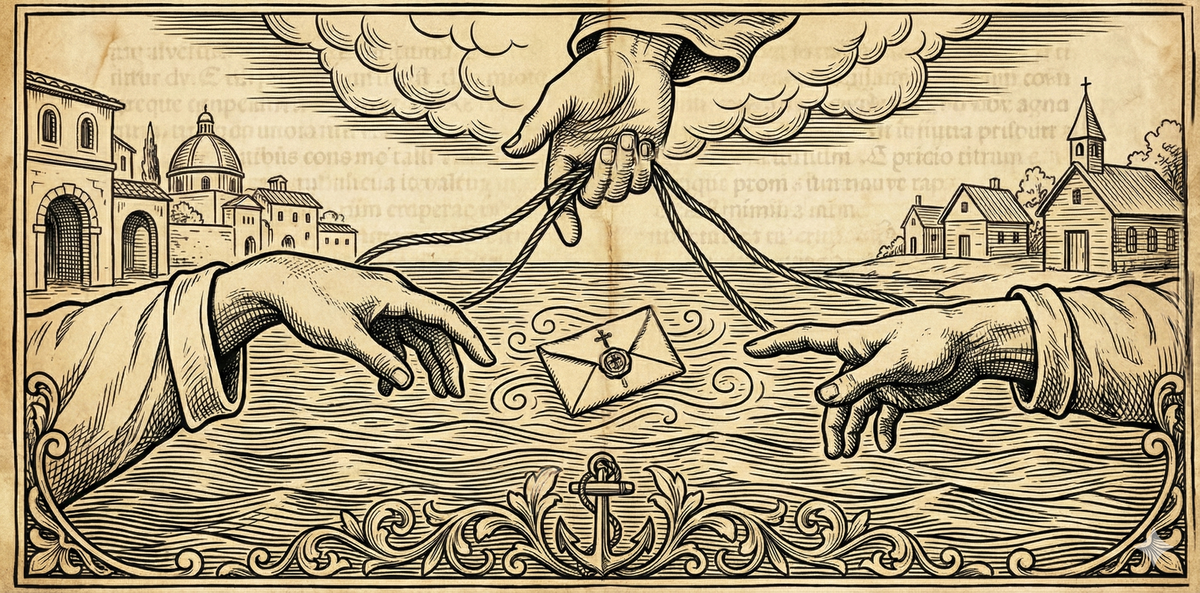
(Or: A 40-Year Trans-Atlantic Family Reunion)
Providence via WhatsApp
(Or: A 40-Year Trans-Atlantic Family Reunion)
My mother lost her native tongue somewhere between Naples and Minnesota, married to an American soldier at nineteen and transplanted into a life where no one spoke the language of her childhood. By the time I was old enough to ask her to teach me Italian, she'd forgotten most of it herself—not through choice, you understand, but through the slow erosion that comes from having no one with whom to practice. The last time she heard from her sisters in Italy was 1985, via written letter. Forty years of silence, punctuated only by the small replica photograph of Grandma Lina that survived countless moves, the faces of three young women frozen in their Mediterranean youthfulness, a world away from everything my mother had become.
Nine days ago, one of those sisters died. Her name was on my mother's lips when she passed, along with the name of the one sister who remains.
And then two Italian cousins found us on Facebook.
The Mundane Work of Providence
Really, when I think about what happened here, I'm struck by the sheer mundanity of Providence. There was no burning bush, no angelic messenger, no voice from heaven declaring the hour of reconciliation. Just a message request from an Italian woman, followed by one from another Italian woman, both daughters of the sisters my mother hadn't spoken to since Reagan's first presidency. They'd been searching for us for years—through consulates, through Italian television programs that specialize in family reunions, through every database they could access. One month before her own death, one of the sisters told her daughter to write down the names of my mother's four children. And then, in that narrow window between one sister's passing and the discovery that another still lived, they found my half-sister on a messaging platform I generally try to avoid.
I am not, as a rule, keen on entrusting my communications to Zuck's surveillance apparatus. But Providence, it turns out, is indifferent to my preferences. GOD used WhatsApp—Meta-owned, data-hoovering, algorithm-driven WhatsApp—to help weave together the threads of our family tapestry that had been hanging loose for four whole decades. Which is precisely the sort of thing Providence does: utilize natural processes (even corrupt ones) to achieve supernatural ends.
Providence vs. Miracle: Why the Distinction Matters
This distinction matters more than most Christians realize. A miracle, properly defined, is a total and undeniable interruption of natural processes—water turning to wine, dead men walking out of tombs, the Red Sea parting on command. These things cannot happen unless GOD suspends the laws He established. But Providence doesn't suspend anything; it directs. It guides the ostensibly autonomous decisions of billions of human beings in such a way that GOD achieves His own ends, which He determined before laying the world's foundations. My cousins didn't search for us because an angel appeared and commanded it; they searched because their mother, in her grief and longing, told them to write down our names. Facebook didn't reunite us by divine fiat; it connected us because someone clicked "Add Friend" and the algorithm did what algorithms do.
The weak seek miracles. They demand proof, spectacular signs, undeniable wonders that leave no room for faith because faith has been obliterated by certainty. Gideon asking for fleece-drying and dew-soaking. Thomas demanding nail-scarred hands. The Pharisees perpetually requesting one more sign, as if the previous hundred weren't sufficient. But the mature—those whose faith has been sandpapered into something resembling steadfastness—see GOD's hand in everything. They don't need the spectacular because they've learned to recognize the sacred intent behind the ordinary, the divine orchestration hidden inside what looks, to the untrained eye, like mere coincidence.
Divine Timing and Sovereign Purpose
My mother's youngest sister died on December 18th, her final words a cry for the siblings she hadn't seen in forty years. Several days later, we held our first WhatsApp video call—my mother, her surviving sister, my cousins, and me, fumbling through Google Translate and AI-assisted Italian because I never learned the language and my mother has forgotten most of hers. The timing is exquisite—and I don't mean that sentimentally, but observationally: one sister passes; the other remains; the daughters find us in the days between death and discovery. Tell me that's coincidence. Tell me that's random. Tell me it doesn't bear the fingerprints of a GOD who wastes nothing, not even decades of silence, linguistic barriers, or even the data-mining tools of big tech.
This is the scandal at the heart of Reformed theology: GOD's sovereignty doesn't merely permit these things; it ordains them. The separation, the silence, the death, the reunion—all of it woven together into a tapestry we're too small to see in its entirety but get to glimpse in fragments when things align just so. My cousin believes her deceased mother guided them to us from beyond the grave; I believe a sovereign GOD ordained the entire sequence before time began, including her mother's death, including her final words, including the month-earlier instruction to record the names of remote relatives. We're looking at the same facts through different lenses, and while I can honor her faith and her grief, I cannot abandon the theological precision that insists: this is Providence, not miracle; orchestration, not intervention; the natural processes of human choice bent—however mysteriously—toward divine ends.
Can I fully explain how GOD achieves this without completely nullifying human agency? No. Our minds are too limited to parse the mechanics of divine sovereignty intersecting with creaturely responsibility. But our inability to comprehend it doesn't diminish its truth any more than a child's inability to understand college math makes calculus false. GOD is sovereign. Man is responsible. Man has some measure of autonomy, some sphere of choice. And yet GOD's purposes supersede all of it, guiding, directing, ordaining what looks to us like randomness but is, in fact, meticulous care.
When we finally connected that Saturday afternoon, faces appearing on screens separated by an ocean and four decades of silence, I expected tears. What I witnessed instead was something closer to wonderment—my mother and her sister staring at each other through the imperfect mediation of smartphone cameras, my cousins gesturing enthusiastically in rapid Italian that we could barely follow, all of us grinning like fools despite the communication barriers. The theological precision of Providence vs. miracle was, predictably, the furthest thing from anyone's mind. We were too busy fumbling with Google Translate, too occupied with the simple marvel of seeing faces we'd only known through old photographs now moving, speaking, present in ways that the long years of absence had made seem impossible.
We've scheduled a second call for New Year's Day, and I suspect it will go much the same—halting conversations stitched together with AI assistance, expressions doing more communicative work than words, the profound strangeness of reconnecting with people who are simultaneously strangers and kin. And the fact that GOD used a platform I distrust to facilitate what no amount of human effort achieved in forty years won't diminish the beauty of these moments—it will magnify them. Because that's what Providence does. It takes the broken, the corrupted, the insufficient, the mundane, and weaves it all into something that proclaims: GOD is here, working all things according to the counsel of His will, and no silence is too long, no distance too great, no barrier too formidable for Him to overcome when the appointed time arrives.
My mother didn't get a miracle. She got something better: the quiet, patient, unstoppable work of a GOD who ordains reunions in His time, not ours, through tools we would never choose, for purposes we cannot fully grasp but are invited—commanded, even—to trust.
That's Providence. And it's enough.