Christianity Is Truth Incarnate
The day after Christmas, what remains when the decorations come down? A truth claim that stands or falls on one historical fact: God became flesh. Here's why that matters.

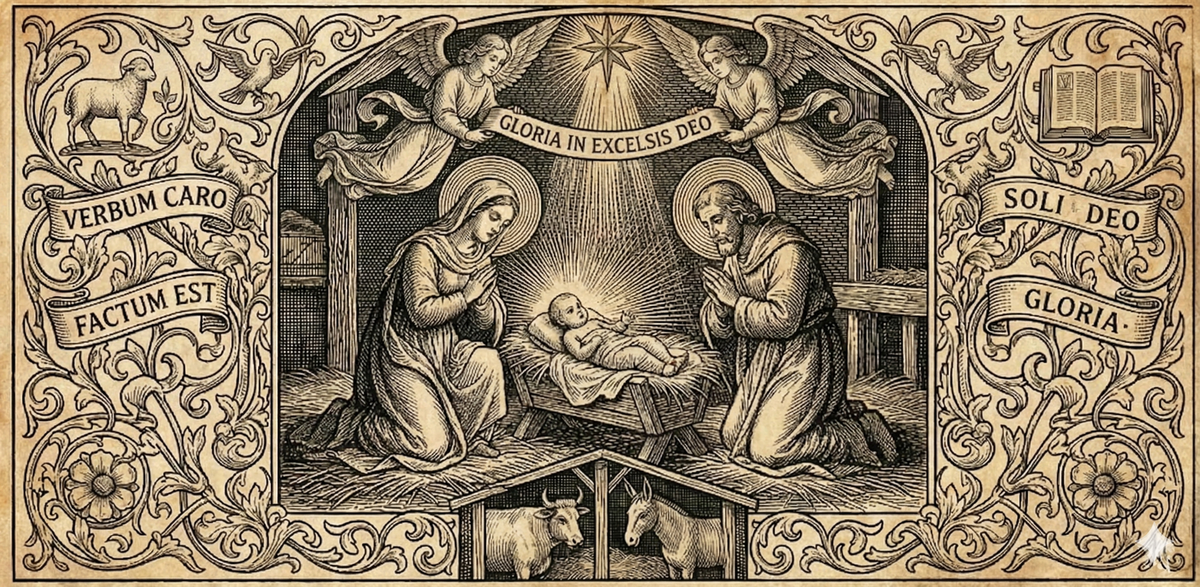
It's December 26th. The wrapping paper's in the trash. The ham is eaten nearly to the bone. The nativity set has another week on the mantle before being boxed up and returned to the attic for eleven months of hibernation (10 for the zealots!). And we're left with the question that always looms larger the day after Christmas than it ever does the day of: what...exactly...just...happened?
For true believers—and indeed all true believers throughout time—Christmas has never been about the trappings. It's always been about the birth of Christ. The intersection of time between before He came and after He came. Christ is the great time divider, the ultimate splitter of the space-time continuum, if you will. History itself bends around Him; we've embedded that fact into our calendars whether we acknowledge it or not. B.C. and A.D. are not arbitrary markers. They're theological claims dressed up as chronology.
But here's the thing: we needed Christ. Desperately.
His advent—His coming—was never just a nice idea or a sentimental story about a baby in a manger. It was the linchpin of God's grand story of redeeming mankind from His own wrath and from our ultimate, impending destruction. The story of Christmas goes all the way back to the story of Genesis. God's story. Or, as I like to say, His-story—which is actually one of the most accurate words in the English language when you think about it. History is literally His story.
And that story starts before the beginning of time, before the creation of the universe. God, perfectly triune, perfectly self-sufficient, and perfectly content therein, decided—took it upon Himself—to create a physical universe and place in it His crowning achievement: mankind. For reasons we can't fully wrap our finite minds around, He built into man the capacity for rebellion, disobedience, and disconnection from Him, our Creator. And it all serves as a grand stage, a theater in which He could demonstrate His attributes.
The Questions We Can't Avoid
So many things tie into this grand topic. Theodicy, for one: why does God allow so-called bad things to happen to so-called good people? And what's the meaning of man? What's his purpose for existence? Why was he created? Why is he here? What's the point?
And then there's the big one: who is God? What's He all about? What's His nature? Can we even know?
These are all facets of the grand narrative God decided He would tell before a watching creation—not only the physical creation, but the spiritual creation. Angels, not being physical creatures themselves but spiritual ones, are still creatures, meaning they are created beings. God put on this grand display, this demonstration, to make it clear to everyone who is not Himself that He is God. He bears all the right attributes to the fullest extent and in the most glorious sense possible. He is the source and origin of all that is good, perfect, holy, and true.
And He decided to demonstrate that in what we consider to be a grand and long demonstration—I hesitate to say performance, but in any case, it's His story.
From Perfection to Redemption
It started before creation. It was initiated before the watching world at creation. And it went from perfection in the Garden of Eden to centuries of travail, hardship, pain, death, destruction, and suffering. All of which brought us to the arrival of the Redeemer–who was the Christ child but who is now the soon-coming, all-reigning King.
Born of a virgin. Born under the Law. And born to die.
And this is where the Incarnation stops being a Hallmark card and becomes the hinge on which all of Christianity swings. Christianity isn't just about ideas or principles. It's not a philosophy to be merely abstracted into platitudes and motivational quotes. It's about a physical, historical person who stepped into time and space, took on flesh, lived a sinless life, then bore the sins of all who would ever believe on a cross made just for Him.
That's not mythology. That's not allegory. That's truth incarnate.
Why Physicality Matters
Here's what separates Christianity from every other religious or philosophical system: we don't have the luxury of retreating into abstraction. Our entire faith stands or falls on whether or not a specific Jewish man named Yeshua of Nazareth was born, lived, died, and rose again in first-century Palestine. Paul, his apostle, was so certain of this he wrote, "If Christ has not been raised, your faith is futile; you are still in your sins" (1 Corinthians 15:17).
No other religion ties itself so thoroughly to verifiable historical events. Buddhism doesn't depend on whether Siddhartha Gautama existed. Islam doesn't hinge on Muhammad's resurrection. Hinduism is fine with myth and metaphor. But Christianity? We've nailed our colors to the mast of history. Either the tomb was empty or it wasn't. Either God became flesh or He didn't. There's no third option—no pat of His head, thanking Him for His "good moral example."
And that's precisely what makes Christianity true in a way that ideas can never be. Ideas can be beautiful. They can be inspiring. They can even be useful. But they can't redeem a sinner from divine justice. They can't conquer death. They can't split history in half.
Only the God-man can do that.
What Christmas Actually Means
So ultimately, Christmas is about creation. It's about redemption. And it's about glorious consummation yet to come. Because the Incarnation doesn't just point us backward to Bethlehem; it points us forward to that great day when the same Christ who entered the world through a door of flesh will return through a parted sky to set all things right.
The decorations will go back up the ladder. The ham will be a distant memory. The wrapping paper will decompose in a landfill somewhere. But the truth claim at the center of Christmas—God became man so that man could be reconciled to God—that claim ever remains. It demands a response. Not sentiment, not tradition; a response.
Because Christianity is truth incarnate. And truth doesn't ask permission. It simply is.