When February Feels Like Lent
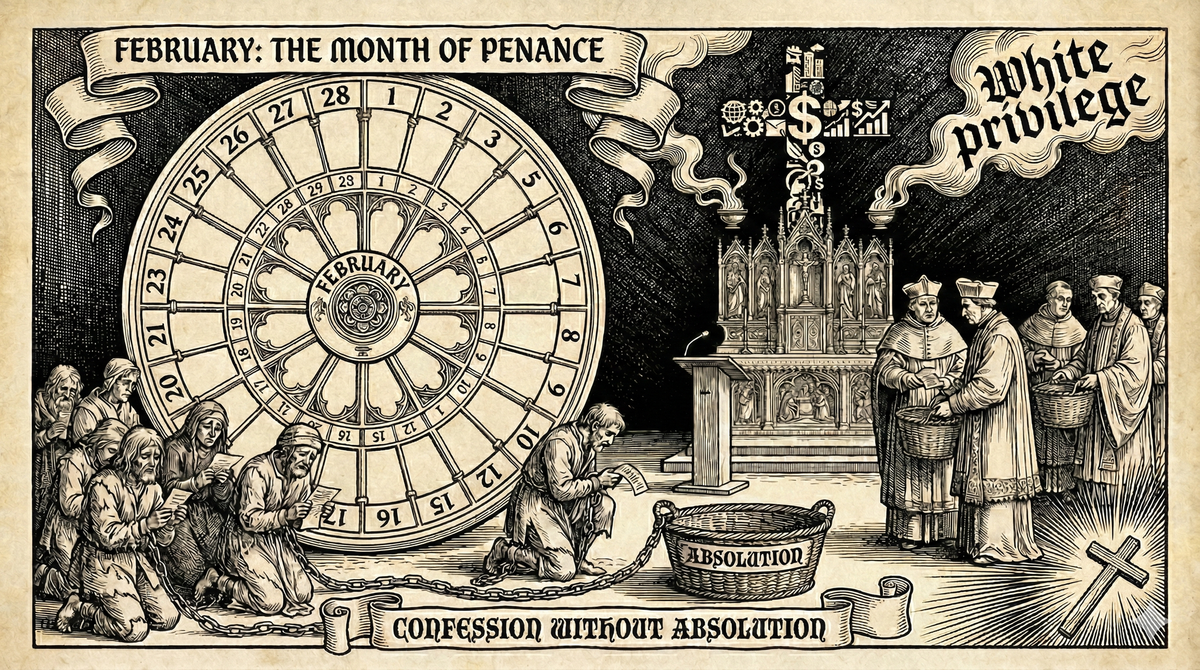
Black History Month has become America's secular Lent—a month of imposed penance without absolution. The gospel offers actual reconciliation instead.

When February Feels Like Lent
Every February, corporate America changes its logo. School assemblies feature special presentations. Social media timelines fill with carefully curated posts about struggle and progress. And somewhere beneath all the performance, a liturgical calendar ticks along—twenty-eight days of imposed penance for sins most people didn't commit, seeking absolution that never quite arrives.
Black History Month has morphed into something peculiar: America's secular Lent. Not the kind that leads to Easter morning, but the kind that cycles endlessly, year after year, with confession but no forgiveness, repentance but no redemption. Just an annual dose of incense to the gods of racial grievance, hoping this year's offering might finally be enough.
It never is.
John McWhorter noticed this years ago. He pointed out that what we're dealing with isn't just politics or social activism—it's religion. Complete with its own original sin (white privilege), its own saints and devils, its own rituals of purification. And like all religions, it has its priests who profit from the faithful's fear of damnation.
The Liturgy of Guilt
The parallel to Lent isn't perfect, but it's close enough to be instructive. Traditional Lent begins with Ash Wednesday—"Remember that you are dust, and to dust you shall return." The point is repentance: acknowledging sin, seeking forgiveness, receiving grace. The season ends with resurrection.
February's liturgy follows a different script. It begins not with dust but with privilege. The sermons aren't about personal sin but inherited guilt. And instead of leading toward reconciliation, the whole exercise just...loops. Confess your advantages. Acknowledge your complicity. Demonstrate your awareness. Then do it again next year, because there's no mechanism for absolution built into the system.
That's the thing about wokeism's doctrine of racial sin—it offers no final resolution. You can't be forgiven because the sin isn't really yours to begin with; it's structural, systemic, baked into your skin. The best you can do is perform ongoing penance and hope the mob doesn't turn on you this year.
Biblical Christianity says Christ died for sins past, present, future—all of them. It's a finished work. Wokeism says you're still paying, and your children will be too, and their children after that. It's less a faith than a multi-generational shakedown.
The Profiteers of Penance
Here's where the analogy gets really uncomfortable: every religion needs its clergy. And America's racial guilt industry has produced some prime entrepreneurial candidates.
Jesse Jackson built a career on it. Al Sharpton perfected the model. Shaun King & others like him have kept the grift alive for newer generations. The playbook hasn't changed much: identify a grievance, amplify it through media, monetize the outrage, rinse and repeat. These aren't pastors offering reconciliation; they're merchants selling indulgences. Pay your guilt tax and maybe—just maybe—they'll pronounce you one of the good ones.
The 2020 summer of George Floyd showcased the operation at industrial scale. Black Lives Matter, the organization, raked in tens of millions from corporations desperate to demonstrate their virtue. Where did the money go? Certainly not to the black communities supposedly being served. Luxury real estate seemed like a higher priority.
But it's not just about the obvious hustlers. There's a whole ecosystem of consultants, diversity officers, and professional grievance-mongers who've discovered that keeping the wound open pays better than letting it heal. They're not interested in reconciliation—that would put them out of business. The model requires perpetual victimhood, which requires perpetual villains, which requires...well, you get the picture.
And beneath all the professional grievance-peddlers are the regular folks who've bought the theology: convinced that their anger is righteous, their demands justified, their retribution somehow restorative. They're playing off white guilt, sure, but they're also playing into their own bondage—because victimhood is a cage that mostly locks from the inside.
The Gospel Alternative
Christianity—actual Christianity, not its race-constrained knockoff—offers something radically different: true forgiveness for actual guilt.
Not inherited sin. Not systemic culpability for things you didn't do. Not endless penance for the color of your skin. Just straightforward acknowledgment of real wrong, genuine repentance, and complete forgiveness. If we confess our sins, he is faithful and just to forgive us our sins and to cleanse us from all unrighteousness. Past tense. Finished work. Done.
That's the scandal of the gospel—it actually resolves what it claims to address. You sinned? God forgives. Your ancestor sinned? That's between him and God. Someone sinned against you? Forgiveness is still available, and it doesn't require the perpetrator's cooperation. It's not therapy. It's not process. It's not performance. It's transaction: grace exchanged for guilt, righteousness for rebellion.
Paul wrote in 2 Corinthians that "if anyone is in Christ, he is a new creation." The old is gone. A new creation has arrived. Not "the old requires twenty-eight days of annual acknowledgment." Not "the old must be perpetually confessed by your descendants." The old is gone. New creation has arrived. The dividing wall between Jew and Gentile? Christ demolished it. Not relocated it. Not renamed it. Demolished it.
Racial reconciliation—of the actual kind—requires gospel, not grievance. It requires acknowledging that yes, slavery happened, Jim Crow happened, genuine injustices were perpetrated. But it also requires acknowledging that guilt belongs to the guilty, forgiveness is available to all, and the solution to division isn't more sophisticated division. It's unity in Christ, where "there is neither Jew nor Greek, slave nor free, male nor female"—and we might add, neither black nor white—"for you are all one in Christ Jesus."
Black History Month as currently practiced isn't reconciliation. It's racialized ancestor worship married to performative penance. It's a month-long guilt trip disguised as education, a liturgical calendar built on the premise that some sins are inherited through melanin.
February doesn't need to be Lent. It could just be February—twenty-eight days like any other, where we include worthy figures in their proper context without segregating them into a special month, where we acknowledge both the good and the ugly of American history without imposing generational guilt, where we pursue actual justice without professionalizing grievance.
But that would require something the current system can't provide: absolution. And you can't sell absolution when you've built a religion that doesn't offer any.
The gospel does. It's time we tried that instead.