Trans and Triggers
Ancient heresy meets modern firearms. When a culture teaches its children the body is a lie, some of them eventually believe it about other bodies too.

Children were playing hockey in Pawtucket, Rhode Island, on Monday afternoon. Children were praying at Mass in Minneapolis last August. Children were sitting in classrooms in Tumbler Ridge, British Columbia, a week ago. And in each case, someone walked in and began shooting.
I'm interrupting the Black History Month series for this because the moment demands it. Three mass shootings linked to trans-identified individuals in six months — four in under a year, if you count the assassination of Charlie Kirk last September. The cultural conversation is white-hot, and few are getting it right. The populist right wants to call this "trans terrorism." The progressive left wants to call it statistically insignificant. Both are dodging the harder question, which is fundamentally theological.
It begins with the body.
The Body Count of Body Denial
First, a brief litany, because the corporeal weight of these events must not be abstracted away by either side's talking points.
On February 16 — yesterday, as I write this — Robert Dorgan, a 56-year-old biological male who had undergone surgical transition in 2020 and went by "Roberta Esposito," opened fire inside a hockey arena during his own son's game. He killed two family members, critically wounded three others, then killed himself. Police have classified it as a domestic dispute. The day before, Dorgan had posted on X in response to conservative figures criticizing trans ideology: "keep bashing us. but do not wonder why we Go BERSERK." Dorgan, it bears noting, was a self-described Trump supporter and right-winger — a detail that should complicate the narrative for anyone trying to make this fit into a tidy political box.
One week earlier, on February 10, Jesse Van Rootselaar — an 18-year-old biological male — killed his mother and stepbrother at home, then drove to Tumbler Ridge Secondary School in British Columbia and murdered five students and a staff member before taking his own life. A total of 9 were slain. Van Rootselaar had been sharing videos of the Nashville Covenant School shooter on TikTok and had built a mass-shooting simulator on the popular online game platform, Roblox. It was Canada's deadliest school shooting since 1989.
Last August 27, Robin Westman, 23, opened fire during a school-wide Mass at Annunciation Catholic Church in Minneapolis, killing two children — ages eight and ten — and injuring 18 others. Westman had, at one point, identified as transgender and later expressed disillusionment with it, writing in his diary that "gender and weed" had wrecked his mental health. His weapons bore anti-Catholic, antisemitic, and Satanic markings, including inverted pentagrams. The FBI classified the attack as domestic terrorism and an anti-Catholic hate crime.
On September 10, 2025, Charlie Kirk was assassinated at Utah Valley University by a 22-year-old who lived with a transgender romantic partner and had, by family accounts, turned sharply leftward and become intensely focused on trans advocacy. Kirk was killed moments after an audience member asked him about transgender mass shooters — a detail so chilling it barely needs commentary.
And the case that started the public conversation: Nashville Covenant School, March 2023. Audrey Hale, a biological female who identified as transgender, killed three children and three adults at the Christian school.
Now for statistics: by the broadest tracking measures, trans-identified individuals account for fewer than one in a thousand mass shooting suspects over the past decade — a small fraction by any measure. I'm not making a statistical argument but rather an observational one. The qualitative pattern is what warrants serious attention: the targets skew toward Christian institutions, the manifestos reference nihilism and anti-religious hatred, the copy-cat dimension is documented, and the ideological ecosystem connecting these acts is real — even if it doesn't map onto the simplistic "trans people are disproportionately violent" claim.
Gnosticism 3.0: the soul devours the body
I've written before about what I call ethnic gnosticism — the heresy that claims special spiritual knowledge on the basis of skin color. The framework applies here too, with a darker edge.
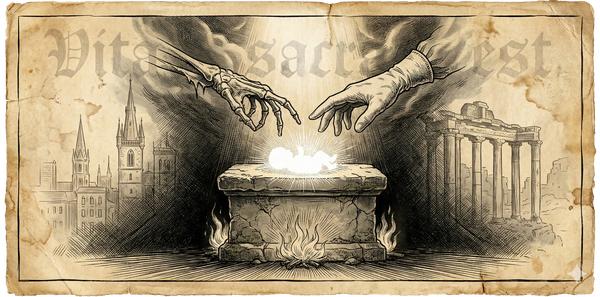
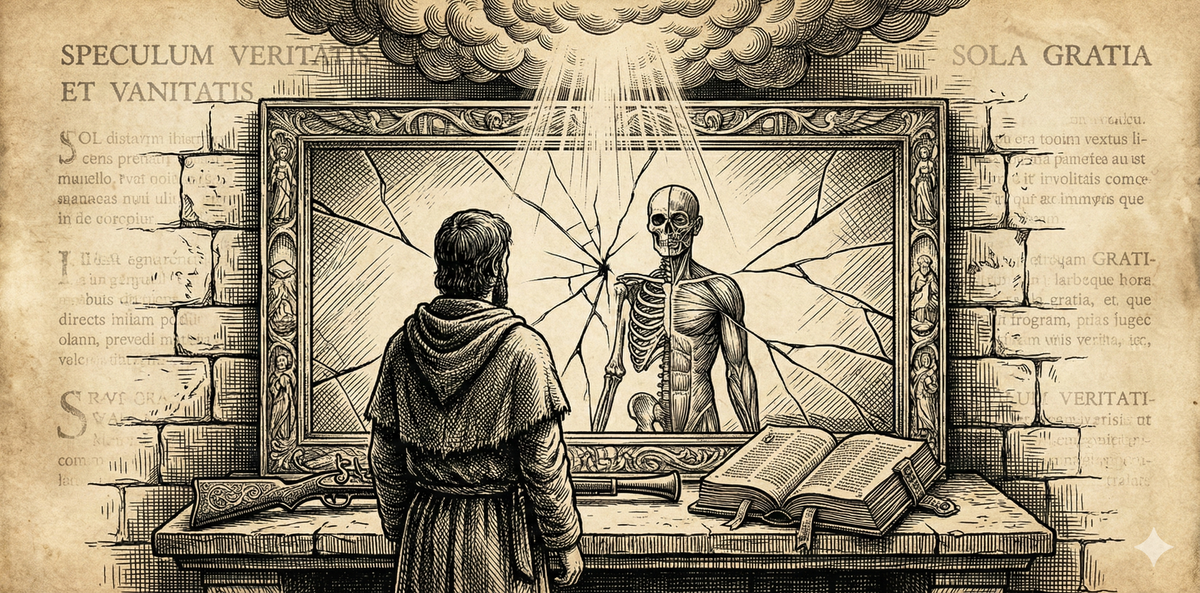
The ancient Gnostic schools of the second and third centuries despised the material world. The body, in their view, was a cage — corrupt, irredeemable, the work of a lesser deity. Liberation meant escaping it. The immaterial soul was the "true self," and the physical form was, at best, an inconvenience and, at worst, a prison. The early Church fought this heresy with everything it had, because it understood what was at stake: if the body doesn't matter, then nothing done to or with the body matters either.
Trans ideology is Gnosticism 3.0. The claim that one's "true self" is imprisoned in the wrong body — that the immaterial identity must override the material reality of chromosomes, anatomy, and biological design — is not a new idea. It's one of the oldest heresies in the book, repackaged in clinical language and sold as civil rights. And just as the original Gnosticism produced contempt for physical creation, this version is producing contempt for physical bodies — starting, as it always does, with one's own and radiating outward.
Romans 1:18–32 traces the progression with surgical precision: suppressing the truth about GOD → exchanging HIS glory for created things → being given over to a depraved mind. The body is not a costume to be altered at will; it is a declaration by the CREATOR. To wage war against it is to wage war against the ONE who made it — and the wreckage is not merely spiritual.
A commentator I heard some time back put the common thread bluntly: whether it's abortion, whether it's the mutilation of children, whether it's radical feminism or the transgender phenomenon — the common thread is that there's no GOD, no redemption, no salvation, just an obsession with death. He called it a "death cult," and the label, while provocative, isn't wrong. Another observer described the nihilism undergirding it all as "black tar spilling into the mental ethosphere, especially with teens." That's vivid, and — given the copy-cat patterns among young shooters — uncomfortably accurate.
The connection to Abigail Shrier's research is worth noting: the preponderance of this phenomenon, she's demonstrated, is largely socially induced. This would make it less a psychiatric diagnosis in most cases and more a symptom of a deeper cultural sickness — a sickness that, in its most extreme manifestations, produces people who don't merely deny their own bodies but deny the sacred weight of other people's bodies too.
Neither Dragnet nor Dismissal
Here's where neither the populist right nor the institutional left is offering a coherent response — and where a classical liberal framework grounded in Reformed theology actually has something distinctive to say.
The DOJ has floated a proposal to classify gender dysphoria as a disqualifying mental condition for gun ownership. I regard this as sloppy at best and unconstitutional at worst. Stripping a constitutional right from a class of people based on self- (or others-)declared identity rather than adjudicated individual conduct is collectivist logic, and it's portable — a future administration could apply the identical framework to any disfavored group.
The Heritage Foundation's push to create a "Trans Ideology-Inspired Violent Extremism" (TIVE) classification for domestic terrorism reflects, I think, a misunderstanding of the fundamental nature of humanity. Reformed theology already has a category for this: total depravity. It applies to every one of us. Designating breakaway terrorism categories for specific types of wickedness is a game we've been playing for too long, and I think we've gone from sensible legal designations to borderline reactionary ones.
Attorney General Bondi's directive to offer cash bounties for information on transgender activists promoting "radical gender ideology" — the mechanism itself isn't inherently objectionable. Bounties tied to demonstrable threats of violence are standard enforcement tools. And let's be honest: the principle that government should never act on ideology — only on conduct — is already a fiction. The entire post-9/11 counter-terrorism architecture operates on the premise that certain ideologies produce a demonstrable, structural nexus to organized violence, and that intervention before the act is both legitimate and necessary. Nobody serious calls that thought policing. We call it counterterrorism, and the reason it holds is that the link between jihadist ideology and coordinated mass-casualty operations is documented, institutional, and decades deep.
The question isn't whether ideology ever matters. It plainly does. The question is whether "radical gender ideology" — a phrase with no statutory definition — bears a comparable nexus to organized violence. And the honest answer is no. What we're looking at is a loose pattern of individually radicalized actors, driven through nihilistic online ecosystems that aren't even specifically trans-oriented, producing uncoordinated copy-cat violence with no command structure, no recruitment pipeline, no operational hierarchy. That's structurally closer to incel violence than to jihad-ism — and nobody has proposed cash bounties for promoting "incel ideology," despite a comparable body count. Bondi's directive uses a counter-terrorism instrument where a mental health and content-moderation instrument would be more honest, more precise, and less constitutionally corrosive. "Radical gender ideology" in the hands of this AG targets one group; the tool, unmodified, is perfectly portable to the next AG's disfavored beliefs.
The common error in all three proposals: calibrating categorical legal instruments to a pattern that is real but unorganized — treating individual spiritual wreckage as though it were a coordinated ideological campaign. The problem isn't insufficient legislation; it's insufficient truth. You cannot legislate your way out of a spiritual crisis.
The children at Annunciation were literally praying when the bullets came. The hockey players in Pawtucket were literally playing a game. The students in Tumbler Ridge were literally at school. Ideas have consequences — physical, bloody, irreversible ones. The Gnostic contempt for the body eventually produces contempt for other bodies. When you've been told your own flesh is a lie, the flesh of others loses its sacred weight too.
The only real trans-formation isn't surgical. It's the one that begins when a broken image-bearer encounters the GOD who made the body and called it good — and who, in Christ Jesus, took on a body HIMSELF. The Incarnation is the ultimate anti-Gnostic declaration: the material world matters. Bodies matter. And the ONE who made them is not indifferent to their destruction.