The Theology I Wish I'd Never Learned
A black man's reckoning with a college liberation theology class — and the decade it took to recognize heresy wearing the badge of justice.

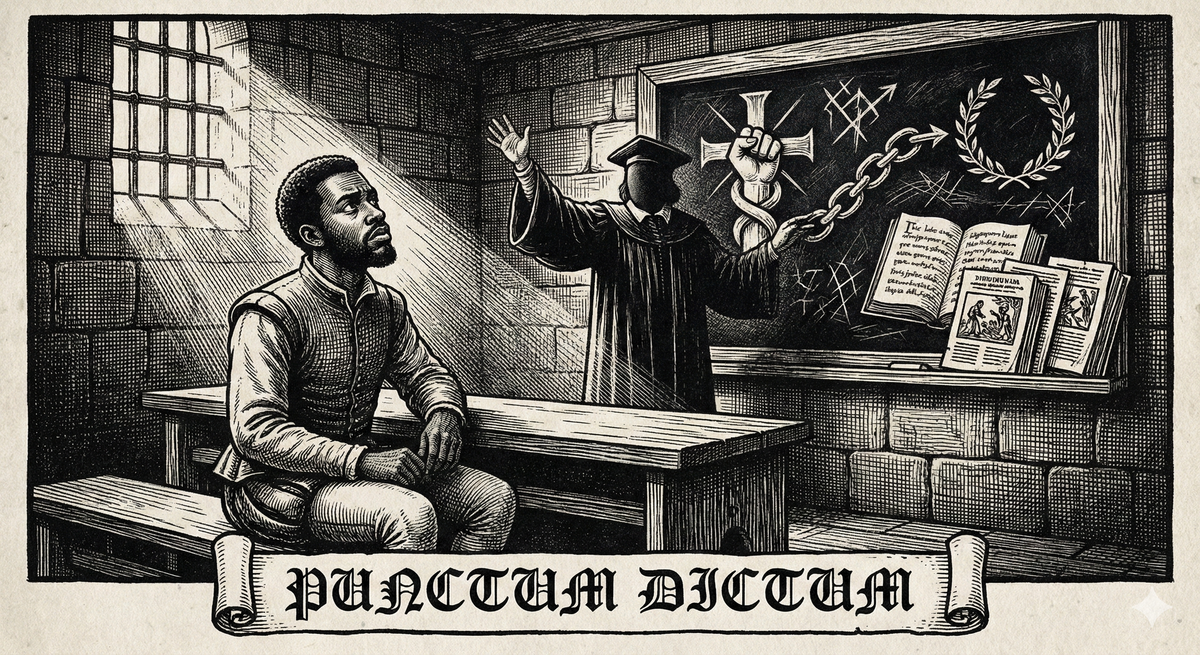
Long before I sat in Dr. Leonard Lovett's black theology class at a well-known charismatic university, something didn't sit right.
I couldn't articulate it then. I was a kid — immersed in a culture where blackness carried its own gravitational pull, its own unspoken code. Most of the people I loved and respected operated within a kind of monolithic sensibility: the white man's motives are always suspect, black folks stick together, and there exists among us an insider ethos that outsiders simply cannot access. I grew up breathing that air. And to be fair, on a raw cultural level, it resonated. It was all I knew.
But even then — young, inarticulate, without the theological vocabulary I'd later acquire — I sensed fractures in the framework. Something about the tribalism struck me as too neat, too self-serving, too small for a world as complicated as the one I inhabited. I didn't have the language to challenge it. I just had the instinct.
I carried that instinct into college and, eventually, into Lovett's classroom.
A Class I Barely Remember
I should be honest: I don't remember the curriculum. I recall snapshots — Lovett standing at the front of the room, holding forth, the atmosphere steeped in a perceived ethos of blackness and how it supposedly found affirmation in Scripture. The whole thing was drenched in sociology and black liberation thinking. The class was an elective, probably taken to fill a gap in my schedule. My attitude was mostly neutral.
One memory does survive, oddly vivid against the fog of everything else. At some point Lovett looked at me and said something to the effect of, "You just like to talk, don't you?" I was a gabby student — I was that kind of kid — and whatever prompted it has long since evaporated. But the moment itself stuck, perhaps because it's the only specific thing I can recall from that entire semester.
I mention this not to embarrass the man but to establish a point: the class left almost no intellectual impression on me at the time. The ideology it represented wouldn't crystallize into something I recognized as dangerous until years later, after a conversion that changed the way I saw everything.
I've written before about the theological ghetto — the way black theology, as I encountered it, didn't apply the gospel to the black experience but subordinated the gospel to racial identity. What I haven't addressed is the personal arc: from sitting passively in that classroom to recognizing, with a clarity that only genuine regeneration provides, that what I'd absorbed wasn't merely a different perspective. It was a different gospel entirely.
From Disdain to Discernment
The turning point wasn't dramatic. It was sanctification.
Roughly ten years after college, the LORD truly regenerated me — not the cultural Christianity I'd professed for years but actual conversion, the kind that repositions a man judicially from enemy of GOD to friend, from slave of sin to slave of righteousness. And what follows genuine conversion, as any Reformed believer understands, is the grinding, beautiful process of being conformed to the image of Christ. Semper Reformanda — always reforming, always being reformed by the power of the Holy Spirit working through us and bringing us into conformity with the One who saved us.
One of the things that reformation process affected in my life was this: what I had previously disdained merely as a flawed way of thinking, I began to see for what it truly was. Not just misguided, but insidious. A framework born from man-centered ideologies — Marxism, socialism, collectivism — draped in biblical language to make it palatable.
Liberation theology, broadly speaking, inverts the gospel. Where Scripture makes Christ the interpretive key to all human experience — including the experience of suffering and injustice — liberation theology makes the experience of the oppressed the interpretive key to Christ. The hermeneutical direction is reversed. GOD becomes a mascot for political grievance rather than the sovereign LORD whose justice and mercy operate on His terms, not ours. The result isn't theology at all; it's ideology with a side of proof-texting.
The Apostle Paul didn't mince words about this sort of inversion. I am astonished that you are so quickly deserting him who called you in the grace of Christ and are turning to a different gospel — not that there is another one, but there are some who trouble you and want to distort the gospel of Christ (Galatians 1:6-7). A "different gospel" that is no gospel at all. That is precisely what liberation theology offers: a counterfeit that borrows Christian vocabulary while gutting Christian substance.
Watching the theological fireworks during the whole MLK50 controversy sharpened this recognition considerably. Seeing erstwhile Reformed, otherwise orthodox black theologians and pastors part ways with their brethren over what amounted to racial identity politics confirmed what I'd been sensing with increasing urgency. Men like Thabiti Anyabwile, who had been solid Reformed voices, began calling the broader church to account for the supposed sins of Puritans who owned slaves and colonial-era figures who were insufficiently vocal against the institution. And while I cannot dismiss every one of those complaints wholesale — some carry legitimate weight — I reject the method. Stripping out nuance. Anachronizing, if I can use that word. Tearing historical figures from their own contexts and measuring them by a standard those figures never had the opportunity to meet. You simply cannot hold a man who lived in 1789 to the moral vocabulary of 2026 without risk of committing a kind of intellectual violence.
There's a bitter irony in the Lovett story I didn't grasp at the time. He and Martin Luther King Jr. both attended Crozer Theological Seminary. Both bore titles that carried weight — "Doctor," "Reverend" — and both, in their respective ways, championed theological frameworks that subordinated the gospel to human agendas. The seminary that shaped them produced men who could speak Christian fluently while meaning something else entirely.
Grief, Anger, and What Theology Ought to Do
If I'm being candid, I feel both grief and anger over this.
Mostly anger, because the Enemy has managed to hoodwink men and women who were otherwise orthodox, who embraced the brethren, who knew the Scriptures — and led them into a tribalism that fractures the very body of Christ. "See to it that no one takes you captive by philosophy and empty deceit, according to human tradition, according to the elemental spirits of the world, and not according to Christ" (Colossians 2:8). That's liberation theology for you: human tradition masquerading as divine mandate.
And yet also grief, because wasted time is the one currency you never recover. Not anger at Lovett the man; I don't know him well enough personally to render that judgment, and I'd rather keep my critique where it belongs: on the ideas, not the individual. But grief over the years spent swimming in an intellectual current that flows away from Christ rather than toward Him. Grief over the young men and women still sitting in classrooms like the one I sat in, absorbing a theology that promises liberation while delivering bondage to racial identity as ultimate category.
The kindest thing I can say about that class is that it helped me develop discernment — by negative example. The harshest thing is that it consumed hours of my life I'll never get back.
Theology, rightly practiced, does one thing: it points to Christ. It takes the full complexity of human experience — black, white, rich, poor, slave, free — and subordinates all of it to the lordship of the One who made every tribe and tongue and nation. The moment theology becomes an adjective — black theology, liberation theology, feminist theology — it has already conceded that something other than Christ sits at the center. And whatever sits at that center, however noble it sounds, is an idol.
"For the time is coming when people will not endure sound teaching, but having itching ears they will accumulate for themselves teachers to suit their own passions, and will turn away from listening to the truth and wander off into myths" (2 Timothy 4:3-4).
That time isn't coming. It's been here a while. It was definitely here when I walked into that classroom decades ago. I just didn't have the ears to hear it at that time.